Chapter 11 Genetics
11.1 The Work of Gregor Mendel
What's your inheritance?
The modern science of genetics was founded by an Austrian monk named Gregor Mendel. Mendel spent several years studying science and started genetics experiments in the monastery gardens on pea plants.
He used ordinary garden peas because they are small and easy to grow. Also, they produces hundreds of offspring in a short life cycle. Today, his research with pea plants is called a model system.
Fertilization
During sexual reproduction, male and female reproductive cells join in a process known as fertilization to produce a new cell (organism). The new cell develops into a tiny embryo encased within a seed.
Flowers are the reproductive organs on plants. Pea flowers are normally self-pollinating, which means that sperm cells fertilize egg cells from within the sam flower. A plant grown from a seed produced by self-pollination inherits all of its characteristics from the single plant that bore it; It has a single parent. Therefore, the traits of each successive generation would be the same. Traits are specific characteristics of an individual.
Cross-Pollination
Mendel decided to cross-pollinate the pea flowers by removing the male reproductive organs from one plants flower and fertilizing the female reproductive organ on another plant. In this way, the new organism will have two parents with different DNA. By crossing two plants with different traits, he was able to study how genes are passed and expressed over generations. Crossing two organisms with different traits creates a hybrid.
Mendel studied seven different traits of pea plants.
When doing genetic crosses, the original pair of plants is called the P or parental generation. Their offspring are called the F1 or first filial generation. The grandchildren of the P generation are the F2 generation.
Much to his surprise, when Mendel crossed two plants with different traits, only one of the traits showed up in the offspring. Where did the other one go?
Mendel drew two conclusions:
1. An individual's characteristics are determined by factors that are passed from one parental generation to the next. Today we call these factors genes. Different forms of a gene are called alleles. For example, everyone has a gene for eye color. The different alleles for eye color might be blue, brown, green, and hazel.
2. Principle of Dominance: states that some alleles are dominant and others are recessive. An organism with a least one dominant allele for a particular form of a trait will exhibit that form of the trait. The recessive allele for a particular form of a trait will exhibit that form only when the dominant allele for the trait is not present.
Mendel discovered that the round seed shape, yellow seed color, gray seed coat, smooth pod shape, green pod color, axial flower position, and tall plant height were the dominant alleles for pea plants.
If recessive alleles disappear in the 2nd generation, where did they go?
Mendel continued to breed the 2nd generation with itself by self-pollination and found that the recessive traits showed up again in the 3rd generation.
Mendel assumed that a dominant allele had masked the corresponding recessive allele in the F1 generation. However, because the recessive trait showed up in the F2 generation. This showed that the F1 plants carried the recessive allele.
Segregation
During the production of gametes (sex cells), eggs and sperm, reproductive organs undergo meiosis. Meiosis produces cells with half the normal number of chromosomes. Therefore, the sperm and egg cells only carry one allele for each genes. This is a product of meiosis, or segregation:
After each parent cell segregates and forms gametes, the offspring could inherit either of the two parent's alleles, strictly by chance of which gamete it formed from.
For 11.1 powerpoint please click link below:
https://docs.google.com/presentation/d/1z57BO3TQKotC62yP5b8kgyRSz6jg_8j7aBisEnEA1Ts/edit?usp=sharing
11.2 Applying Mendel's Principles
Probability
Probability is the chance that an event or outcome will occur. Mendel uses probability to describe the different probable outcomes of offspring after cross-pollinating.
In a coin flip, there are two sides to a coin so there are two possible outcomes. The probability that the coin will land on one of the two sides is 1/2, or 50%.
In segregation, each of the two parent alleles separate to form gametes or sex cells. The gametes then only carry one of the parents alleles. The parent has a 50-50% chance of passing on either allele to their offspring. This happens purely by chance. The offspring could inherit either allele from the parent. The new offspring will inherit only one allele from one parent and only one allele from the other parent so that the new offspring now has two of its own alleles.
Homozygous and Heterozygous
Homozygous - organisms that have two identical alleles for the same gene
Heterozygous - organisms that have two different alleles for the same gene
Eye color
Homozygous
BB (homozygous dominent)
or
bb (homozygous recessive)
Heterozygous
Bb (the dominant allele will show up)
Probabilities Predict Averages
Probabilities can predict the average outcome of a large number of events. If you flip a coin twice, you could get one heads and one tails. Or, you could get two heads or two tails.
The larger the number of coin flips, or offspring, the closer the results will be to the predicted values.
Genotype and Phenotype
Every organism has a genetic makeup as well as a set of observable traits.
The
genotype is the genetic makeup of an organism for any given gene. It contains two alleles for that gene. For instance, a persons genotype for eye color could be Bb. (Geno means "race, kind")
The
phenotype is the observable characteristic of the trait. For instance, the phenotype for eye color for a person with Bb would be Brown (even though they also carry a blue gene). (Pheno means "to show")
The genotype can be homozygous dominant, homozygous recessive, or heterozygous.
The phenotype will be only the dominant allele or the recessive allele.
Two organisms can have the same phenotypes but different genotypes.
PUNNETT SQUARES
Punnett Squares use mathematical probability to help predict the genotype combinations in genetic crosses. This diagram is one of the best ways to predict the outcome of a genetic cross.
Using the Punnett Square you can deduce that the offspring will have one of the four above genotypes, BB, Bb, bB, or bb. There are actually only three possibilities because Bb and bB are the same genotype. From these genotypes you can deduce that the phenotypes may be dominant or recessive. In this case the probabilities of having a dominant phenotype is 3/4 or 75% and a recessive phenotype is 1/4 or 25%.
It is possible to determine the probability when two or more factors are involved as well.
In this example, the color of the squares represents pod color. Alleles in black indicate short plants, while alleles in red indicate tall plants
Mendel crossed plants that were homozygous dominant for round yellow peas with plants that were homozygous recessive for wrinkled green peas below.
All of the F1 offspring were heterozygous dominant for round yellow peas.
Below, when Mendel crossed F1 plants that were heterozygous dominant for round yellow peas...
He found that the alleles segregated independently to produce the F2 generation.
Independent Assortment
The principle of independent assortment states that genes for different traits can segregate independently during the formation of gametes. Independent assortment helps account for the many genetic variations observed in plants, animals, and other organisms--- even when they have the same parents!
Summary of Mendel's Principles
Mendel's principles of heredity, observed through patterns of inheritance, form the basis of modern genetics.
1. The inheritance of biological characteristics is determined by individual units called genes, which are passed from parents to offspring.
2. Where two or more forms (alleles) of the gene for a single trait exist, some alleles may be dominant and others may be recessive.
3. In most sexually reproducing organisms, each adult has two copies of each gene---one from each parent. These genes segregate from each other when gametes are formed.
4. Alleles for different genes usually segregate independently of each other.
Mendel's principles apply to all organisms that reproduce sexually. In the early 1900s, Thomas Hunt Morgan used the insect known as the fruit fly, Drosophila melanogaster, to reproduce the same results that Mendel gave. A single pair of fruit flies can produce hundreds of offspring.
For 11.2 Powerpoint click below
11.3 Other Patterns of Inheritance
Exceptions to Mendel's Rules
Sometimes, some alleles are neither dominant nor recessive.
Incomplete dominance - the heterozygous phenotype lies somewhere between the two homozygous phenotypes. Example: if a chicken has incompletely dominant alleles for black and white feathers, the feather may turn out grey.
 |
| In four o'clock plants, the alleles for red and white flowers show incomplete dominance. Heterozygous (RW) plants have pink flowers - a mix of red and white coloring. |
Codominance: the phenotypes produced by both alleles are clearly expressed. Example: in the case of chickens with a black and a white allele, rather than "mixing" the two colors, there will be areas of black and areas of white making the chicken appear speckled instead of grey (incomplete dominance).
Red blood cells carry antigens, molecules that can trigger an immune reaction, on their surfaces. Human blood type A carries an A antigen, type B has a B antigen, type AB has both antigens, and type O carries neither antigen. The gene for these antigens has three alleles; A, B, and O.
Multiple alleles: Many genes exist in several different forms and are therefore said to have multiple alleles. When there are more than two alleles for a gene, there is said to be multiple alleles.
A and B are dominant alleles. O is a recessive allele.
Therefore, a person whose phenotype for blood is A can have AA or AO genotype.
A person whose phenotype for blood is B can have BB or BO phenotype.
A person whose phenotype for blood is O has a genotype of OO, because it is recessive.
And, because A and B are codominant, a person who has a genotype of AB has a phenotype of AB.
O is the universal donor. AB is the universal recipient.
Polygenic Traits - traits that are produced by the interaction of several genes. For example, at least three genes are involved in making the reddish-brown pigment in the eyes of fruit flies. And, human skin color comes from a combination of four different genes.
Genes and the Environment
Environmental conditions can affect gene expression and influence genetically determined traits.
Temperature and Wing Color
Western white butterflies that hatch in the spring have darker wing patterns than those that hatch in summer. The dark wing color helps increase their body heat. This trait is important because the butterflies need to reach a certain temperature in order to fly. The buckeye butterflies shown below also have different wing patterns at different times of year. These butterflies are darker in the autumn than they are in the summer
This is an example of how the environment affects the phenotype of an organism.
For 11.3 Powerpoint click below
https://docs.google.com/presentation/d/1w9s1NFW64ePkqRzUwV1LDfs8PEr9mSOw4mooyafr2kE/edit?usp=sharing
11.4 Meiosis
An organism with two parents must inherit a single copy of every gene from each parent. Matching chromosomes from each parent are called
Homologous chromosomes. This means that, in fruit flies, each of the four chromosomes from the male parent has a corresponding chromosome from the female parent. A cell that contains both sets of homologous chromosomes is said to be
diploid. When an organism produces gametes, those two sets of genes must be separated so that each gamete contains just one set of genes.
Diploid Cells: Having two complete sets of inherited chromosomes, one set from each parent (two complete sets of genes). This is the number of chromosomes that are in all body cells except the ones made in reproductive organs, the sex cells (eggs and sperm). Diploid number (twice haploid) is represented by the letter "2N".
Haploid Cells: Cells that contain only a single set of chromosomes (a single set of genes). The gametes of sexually reproducing organisms are haploid. Gametes are the sex cells (cells meant for reproduction which will combine with another sex cell to make a new organism). Haploid cells are created as a product of two cell divisions (Meiosis). Haploid number is represented by the letter "N".
In fruit flies, the diploid number (2N) of chromosomes is 8. The haploid number is 4.
Meiosis: first stage in sexual reproduction. This is the process of making gametes for reproduction. The parent cell goes through two cell divisions to produce 4 daughter cells with half the number of chromosomes as the parent cell. Each new gamete is genetically different from each other and from the parent cell it came from.
Meiosis, like Mitosis, is preceded in the cell cycle by Interphase. During Interphase, in preparation for cell division, the DNA is duplicated.
Prophase I: After interphase I, the cell begins to divide, and the chromosomes pair up. Each replicated chromosome pairs with its corresponding homologous chromosome.
This pairing forms a structure called a
tetrad, which contains four chromatids. As the homologous chromosomes form tetrads, they undergo a process called crossing-over.
First, the chromatids of the homologous chromosomes cross over one another. Then, the crossed sections of the chromatids - which contain alleles - are exchanged. Crossing-over therefore produces new combinations of alleles in the cell.
Metaphase I: paired homologous chromosomes line up across the center of the cell.
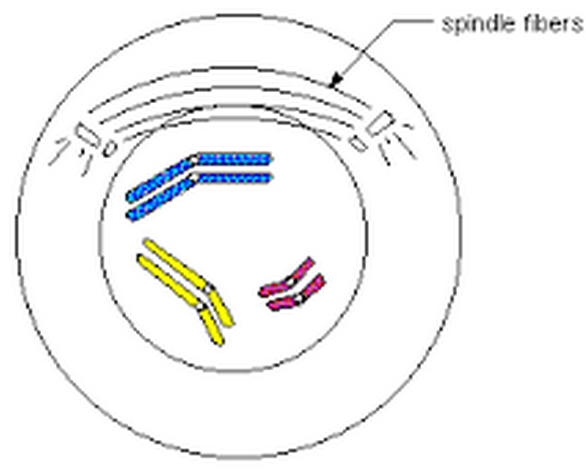
Anaphase I: spindle fibers pull each homologous chromosome pair toward opposite ends of the cell.
Telophase I and Cytokinesis: a nuclear membrane forms around each cluster of chromosomes. Cytokinesis follows telophase I, forming two new cells.
Because of crossing over, the two cells formed from Meiosis I do not have the same exact genetic make up of each other, or the parent cell, since they "traded" some DNA in crossing-over.
Following Meiosis I, the two new cells (2N) now enter immediately into Prophase II. Unlike before the first division, neither new daughter cell goes through a round of chromosome replication before entering meiosis II.
Prophase II: their chromosomes (each consisting of two chromatids) become visible. There are no tetrads, because the homologous pairs were already separated during meiosis I.
Metaphase II: chromosomes line up in the center of each cell.
Anaphase II: the paired chromatids separate.
Telophase II and Cytokinesis: nuclear membranes start to reform around the now haploid nuclei. Cells pinch off resulting in four haploid (N) cells (gametes). In the example (left), each of the four daughter cells produced in meiosis II received two chromosomes.
Gametes - haploid cells produced by meiosis II are gametes that are so important to heredity. In male animals, these are called sperm and all 4 sperm can go on to fertilize and egg. In female animals, these haploid cells are called eggs. Only one of the 4 female gametes will mature into an egg for reproductive purposes.
Zygote - When a sperm fertilizes an egg, these two haploid cells will fuse to form a new diploid cell, the first cell of a new organism. The zygote will then undergo mitosis forming a new organism.
Comparing Mitosis and Meiosis
Mitosis - asexual reproduction, used for growing and repairing in multicellular organisms
Meiosis - sexual reproduction, used to produce gametes for producing new organisms
In mitosis, when the two sets of genetic material separate, each daughter cell receives one complete set of chromosomes. In meiosis, homologous chromosomes line up and then move to separate daughter cells. As a result, the two alleles for each gene are segregated, and end up in different cells. This sorting and recombination of genes in meiosis result in a greater variety of possible gene combinations than could result from mitosis.
Also, mitosis does not normally change the chromosome number of the original cell. This is not the case for meiosis, which reduces the chromosome number by half.
And finally, mitosis is a single cell division, resulting in the production of two identical daughter cells. On the other hand, meiosis requires two rounds of cell division, and in most organisms, produces a total of four daughter cells.
For 11.4 Powerpoint click below